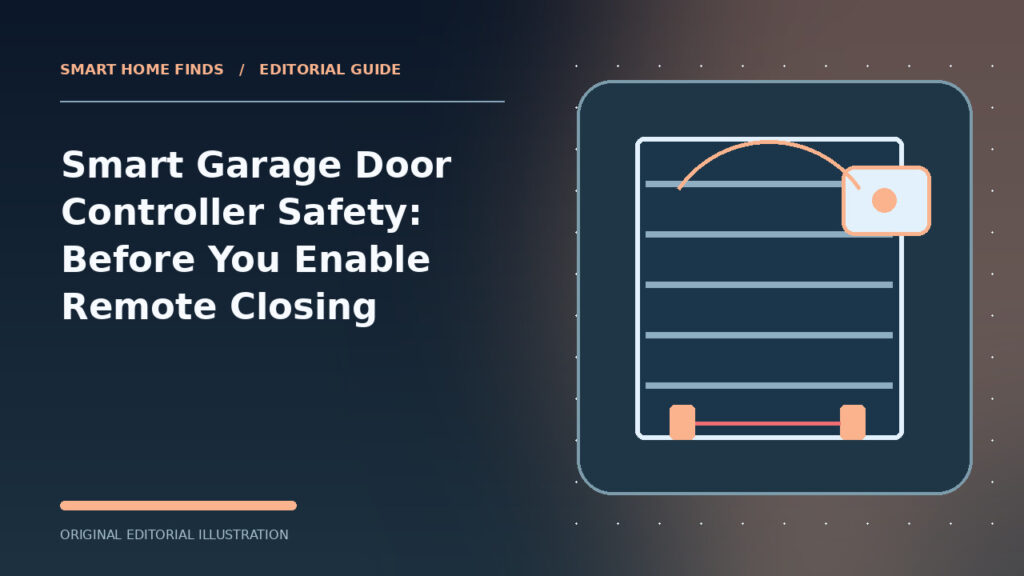

Adding app access to a garage door is appealing when you want to check whether the door is open from another location. However, remote closing changes the risk: the person issuing the command may not be able to see children, pets, vehicles, or objects near the moving door. Treat compatibility and entrapment protection as prerequisites, not optional accessories.
Confirm the opener and accessory are approved together
Start with the garage door operator's exact make and model, installation date, and safety instructions. A third-party relay may be able to trigger a wall-button input electrically while still being unsuitable for unattended operation. Verify explicit approval and required features for remote or unattended closing.
Use qualified installation help when wiring or compatibility is uncertain. Do not modify or bypass the opener's built-in protections merely to make an inexpensive smart adapter appear compatible.
Inspect the existing safety protections
Modern operators commonly use photoelectric obstruction sensing and other protective functions. Check that the equipment is present, correctly aligned, and functioning in the way described by its manufacturer. Do not rely on a phone notification as a substitute for physical obstruction protection.
If a safety sensor is damaged, missing, misaligned, or bypassed, disable remote closing and arrange proper service. Do not place yourself, a child, or an animal in the door's path to test a feature.
Understand unattended closing requirements
Remote operation may require specific warning signals, delay behavior, and protective systems under applicable standards. Requirements differ by country and installation, so follow the manufacturer's approved configuration and local rules. A product supporting remote status viewing is not necessarily approved for remote closing.
Use documented commissioning and functional tests. If the controller offers a vacation mode, guest access, or remote-close permissions, configure those features deliberately rather than sharing the main administrator account.
Verify whether the door is open or closed
A useful system needs a trustworthy door-position signal. Some controllers read a tilt sensor; others use wired contact sensors or information from an integrated opener. The app must be able to distinguish a failed command from a confirmed position change.
Test the sensor with the door in both normal end positions. A command acknowledgment does not prove the door physically moved. Review whether the app identifies a jammed or partially open door.
Plan for power, connectivity, and emergency access
Internet interruptions can block remote controls, while power failures may prevent the motor from operating. Know how the manual release and emergency entry procedures work for your particular installation, and keep those instructions accessible.
Do not disable manual operation in pursuit of automation. Protect the controller account with appropriate authentication and remove guest access when it is no longer needed.
Review notifications without creating alarm fatigue
Open, close, unexpectedly open, and failed-close events may deserve different alert priorities. Test with normal household activity, then adjust notifications so the most important events remain visible. If the garage connects directly to the home, treat access alerts as security signals, not merely convenience updates.
Periodically inspect the door hardware and arrange professional servicing for unusual noise, binding, damaged springs, or inconsistent motion. Springs and other high-tension components are dangerous to service without training.
Checklist before you finish
- Opener and smart controller are explicitly compatible
- Safety sensors pass the manufacturer-approved test
- Remote closing meets applicable installation requirements
- Door position is verified independently of command success
- Manual and emergency operation remain available
- User permissions and notifications are reviewed
The safest connected garage is one whose original protective systems remain intact and whose remote functions are explicitly supported. If you cannot verify those conditions, use status-only monitoring or obtain a qualified inspection before enabling unattended closing.
Further reading: US Residential Garage Door Operator Instruction Requirements (16 CFR 1211.16).
Related guide: Smart Lock Guest Codes: A Safer Plan for Visitors, Cleaners, and Rentals.
Related Smart Home Finds guides
About the Author
Farhan Saputra
Troubleshooting and Maintenance
Farhan Saputra is an editorial pen name used by the Smart Home Finds team for troubleshooting, maintenance, and practical solutions to common connected-home problems. Articles published under this name emphasize step-by-step checks, sensible safety precautions, and knowing when to consult a qualified professional. The site's editorial team prepares and reviews the information. The byline identifies an editorial writing profile rather than a personally certified technician or a claim of firsthand testing.
This content is published through the editorial process of Smart Home Finds. Editorial pen names identify writing roles and do not constitute verified personal identity, employment history, or professional credentials.


